

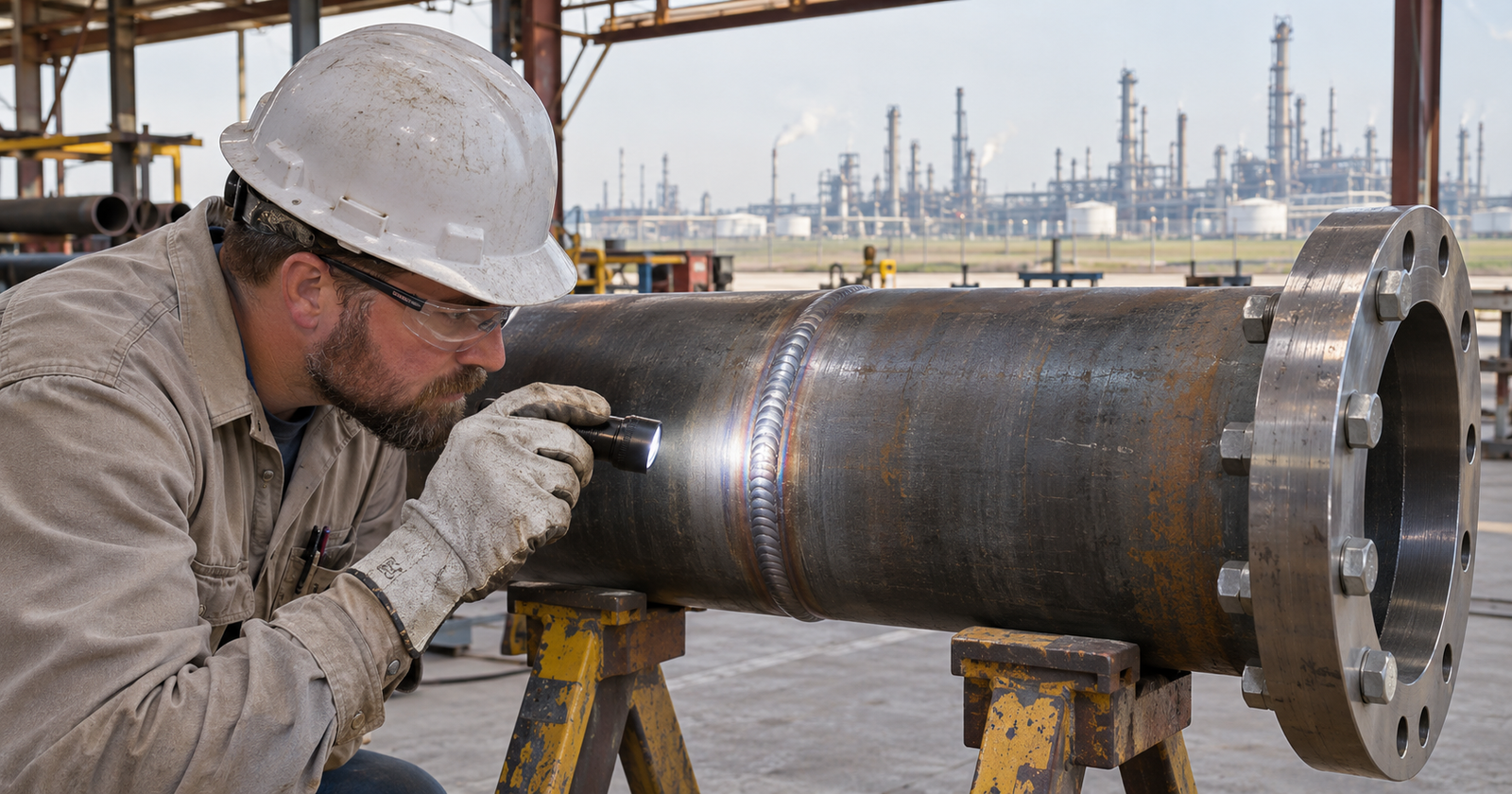
While you’re accountable for sustaining strain gear at a Gulf Coast refinery, there’s little or no room for uncertainty about fabrication high quality. Whether or not you’re changing a worn piping part, getting ready for a scheduled turnaround, or ordering a customized strain vessel, each specification issues. Materials choice, welding {qualifications}, dimensional accuracy, and inspection documentation can affect whether or not a part is appropriate for set up. For high quality assurance administrators, plant engineers, and upkeep managers all through Baton Rouge, LA, understanding ASME necessities is a crucial a part of maintaining industrial initiatives organized and gear working safely.
The ASME Boiler and Strain Vessel Code (BPVC) establishes necessities for the development, fabrication, inspection, testing, and certification of relevant boilers and strain vessels. Nonetheless, refinery course of piping is commonly ruled by separate ASME requirements, significantly B31.3, quite than the BPVC alone. Understanding which code applies to a selected part helps undertaking groups set up the suitable fabrication, welding, inspection, and documentation necessities earlier than manufacturing begins.
Right here’s what Gulf Coast industrial professionals ought to perceive:
- Completely different elements comply with totally different codes: Strain vessels, energy boilers, and refinery course of piping could fall beneath separate ASME necessities.
- ASME certifications have outlined scopes: S and U stamps establish explicit approved boiler and strain vessel development actions, whereas the Nationwide Board administers R stamp restore authorizations.
- Materials traceability issues: Relevant initiatives require documentation establishing that supplies meet the required necessities.
- Welding and inspections require coordination: Certified procedures, personnel, examinations, and testing assist reveal compliance with the relevant code.
- Early planning helps refinery turnarounds: Confirming fabrication necessities earlier than a shutdown may also help keep away from pointless documentation or manufacturing delays.
At Steel Works Company, we’ve been serving industrial clients all through Baton Rouge and the Gulf Coast since 1956. Our skilled workforce offers customized pipe and tube bending, ASME code fabrication, welding, precision machining, and specialty manufacturing providers for demanding industrial purposes. With S and U stamp capabilities and Nationwide Board R stamp authorization, we perceive the significance of working inside clearly outlined code necessities whereas producing elements that match accredited undertaking specs.
What Is the ASME Boiler and Strain Vessel Code?
The ASME Boiler and Strain Vessel Code is a set of technical requirements governing the design, manufacture, inspection, testing, and certification of particular strain gear. For Baton Rouge refineries and chemical vegetation, the BPVC offers a longtime framework for relevant boilers, strain vessels, and associated pressure-retaining elements.
Why the BPVC Issues in Industrial Services
Petroleum refineries and chemical processing services function gear that will comprise fluids beneath elevated strain or temperature. Strain vessels and boilers have to be constructed in line with the necessities relevant to their meant service.
The BPVC establishes technical guidelines that tackle essential features of strain gear development. Relying on the relevant part, these necessities could cowl materials properties, fabrication strategies, welding {qualifications}, examinations, and testing.
For facility managers, these requirements assist create a constant foundation for evaluating gear earlier than it’s positioned into service.
The Distinction Between BPVC and Course of Piping Codes
Some of the essential distinctions includes strain vessels and course of piping.
ASME BPVC Part VIII addresses strain vessel development, whereas ASME B31.3 covers many sorts of course of piping present in refineries, chemical vegetation, and associated industrial services. ASME B31.1 addresses energy piping purposes inside its outlined scope.
These requirements could reference frequent welding qualification or examination necessities, however they aren’t interchangeable.
A customized pipe bend doesn’t mechanically obtain a BPVC certification just because it’s manufactured by a store that holds an ASME authorization. The relevant development code, part classification, and certification necessities have to be established for the actual undertaking.
Which ASME Requirements Apply to Refinery Pipe Fabrication?
The ASME requirements relevant to refinery pipe fabrication rely on the part’s operate, service circumstances, and accredited development necessities. For a lot of refinery course of piping methods, B31.3 offers the first framework, whereas relevant strain vessels and boiler elements fall beneath the related BPVC sections.
ASME B31.3: Course of Piping
ASME B31.3 covers piping generally present in petroleum refineries, chemical vegetation, and associated processing services.
Its scope consists of necessities addressing supplies, elements, design, fabrication, meeting, examination, inspection, and testing.
For initiatives involving customized pipe bends or fabricated piping assemblies, the accountable engineering workforce ought to establish the relevant B31.3 necessities and undertaking specs.
BPVC Part VIII: Strain Vessels
Part VIII offers development necessities for qualifying strain vessels. Division 1 is often related to the U certification designator.
Strain vessel initiatives could require documented materials specs, certified fabrication procedures, examination information, and involvement by a certified inspector.
The required documentation and inspection actions rely on the relevant design and development necessities.
BPVC Part I: Energy Boilers
Part I addresses the development of energy boilers and related elements inside its outlined scope.
The ASME S designator pertains to energy boiler development authorization, not an unrestricted approval for each sort of business piping or strain gear.
Refinery undertaking groups ought to affirm whether or not the work includes boiler gear, course of piping, or one other class earlier than establishing fabrication necessities.
Supporting BPVC Sections
A number of further sections assist relevant fabrication and certification work:
- Part II: Supplies materials specs and properties utilized by relevant BPVC development guidelines.
- Part V: Establishes nondestructive examination strategies and necessities referenced by relevant development codes.
- Part IX: Addresses the qualification of welding, brazing, and fusing procedures and personnel.
- Part VIII: Supplies strain vessel development necessities inside its respective divisions.
- Part I: Supplies development necessities for energy boilers.
Utilizing the right requirements begins with reviewing the relevant code version and undertaking necessities. A fabrication workforce shouldn’t assume that each ASME part applies identically to each part.
What Do ASME S, U, and R Stamps Imply?
ASME S and U stamps and the Nationwide Board R stamp establish totally different scopes of authorization for work involving strain gear. Understanding these distinctions helps Gulf Coast plant managers decide which credentials are related to a specific fabrication or restore undertaking.
S Stamp: Energy Boiler Development
The ASME S certification designator applies to approved energy boiler development beneath the related necessities of BPVC Part I.
It signifies that the certificates holder’s high quality management system has been assessed for the approved scope.
Nonetheless, an S stamp doesn’t imply that each pipe meeting manufactured by the corporate is mechanically code-stamped.
U Stamp: Strain Vessel Development
The ASME U certification designator applies to strain vessels constructed beneath BPVC Part VIII, Division 1.
Manufacturing a qualifying U-stamped vessel includes relevant code necessities for supplies, welding, inspection, testing, documentation, and approved inspection.
For chemical services all through the Baton Rouge industrial hall, this authorization might be related when sourcing new strain vessels for course of gear.
R Stamp: Strain Gear Repairs and Alterations
The Nationwide Board of Boiler and Strain Vessel Inspectors administers the R Certificates of Authorization.
It applies to qualifying repairs and alterations of pressure-retaining objects beneath the Nationwide Board’s relevant necessities, together with NBIC provisions.
Importantly, the R stamp isn’t an ASME BPVC development stamp. It’s a separate Nationwide Board authorization for outlined restore and alteration actions.
Our Code Fabrication Capabilities
We preserve ASME S and U stamp capabilities for relevant store and discipline work, together with Nationwide Board R stamp authorization for qualifying strain vessel repairs.
Our welding and fabrication providers assist industrial clients who want elements manufactured or repaired beneath established specs.
Earlier than starting a undertaking, we evaluation the related scope and necessities to find out which capabilities and authorizations apply.
Why Are Materials Traceability and Welding {Qualifications} Necessary?
Materials traceability and welding {qualifications} are essential as a result of they assist reveal that strain gear has been fabricated utilizing applicable supplies and accredited becoming a member of procedures. For refinery initiatives in Baton Rouge, these controls assist inspection, documentation, and compliance with the relevant development necessities.
Confirming Materials Specs
Industrial strain gear could function beneath circumstances involving elevated temperature, excessive strain, corrosion, or demanding chemical publicity.
Materials choice should account for the accredited design and repair circumstances. In lots of code-controlled purposes, materials documentation is used to determine related specs and properties.
Materials take a look at experiences, warmth numbers, and identification procedures could also be required relying on the part and relevant code.
These information may also help join the completed fabrication to the supplies specified within the undertaking documentation.
Welding Process Specs
A Welding Process Specification, generally known as a WPS, establishes the necessities for performing a specific welding operation.
Relevant initiatives may require supporting Process Qualification Information and documented {qualifications} for the welders performing the work.
ASME Part IX offers the qualification guidelines used for a lot of BPVC purposes and referenced by varied piping codes.
Utilizing certified procedures and personnel helps reveal that welding actions are carried out inside the relevant necessities.
Specialised Alloys Require Cautious Consideration
Gulf Coast refineries and chemical vegetation typically use alloys chosen for explicit temperature, corrosion, or mechanical necessities.
Our welding capabilities embrace supplies similar to titanium, Hastelloy C-276, Incoloy 800-H, and Monel, topic to undertaking necessities.
We additionally present pipe bending and fabrication involving a broad vary of metals and alloys.
The fabrication strategy should account for the fabric’s properties and the procedures required by the accredited specs.
How Do Inspections and Testing Help Code Compliance?
Inspections and testing assist code compliance by evaluating whether or not fabricated elements fulfill the relevant development necessities. Relying on the undertaking, this may occasionally contain dimensional inspections, materials verification, nondestructive examination, strain testing, and approved inspection actions.
Nondestructive Examination
Nondestructive examination permits certified personnel to guage supplies or welded connections with out destroying the part.
Widespread strategies embrace radiographic testing, ultrasonic testing, liquid penetrant testing, and magnetic particle testing.
The suitable technique is dependent upon the fabric, weld configuration, development code, and undertaking specs.
Not each weld requires the identical examination technique or extent. For refinery pipe fabrication within the Gulf Coast, these necessities needs to be established earlier than work begins.
Strain Testing and Dimensional Verification
Sure strain gear and piping assemblies require testing to reveal that they fulfill relevant pressure-boundary necessities.
Relying on the code and design, this may occasionally contain hydrostatic testing, pneumatic testing, or one other permitted technique.
Customized bends may require verification of dimensions, wall thickness, ovality, and different traits following forming.
Testing necessities ought to replicate the accredited development paperwork quite than a generic store process utilized to each undertaking.
Inspection Information and Documentation
Documentation offers an essential file of the work carried out and the inspections accomplished.
Relying on the undertaking, the fabrication package deal could embrace materials information, welding {qualifications}, examination experiences, testing outcomes, and relevant code kinds.
We coordinate documentation and inspection necessities inside our fabrication scope to assist buyer high quality assurance expectations.
For plant managers overseeing shutdown work, figuring out these deliverables early helps stop confusion when elements are prepared for set up.
How Does ASME-Licensed Pipe Bending Match Into Industrial Fabrication?
ASME-certified pipe bending refers to bending work carried out inside an relevant code-controlled fabrication scope, not a separate common certification granted to each curved pipe. Customized bends for industrial purposes should fulfill the development code and engineering specs governing their meant use.
Customized Bends for Refinery Functions
Customized pipe bending can produce specified directional modifications with out assembling a number of separate elbow elements.
This may occasionally scale back intermediate welded connections or accommodate a specific piping association, relying on the design.
Nonetheless, lowering weld depend doesn’t take away the necessity for applicable inspections or reveal code compliance by itself.
The completed bend should fulfill related dimensional, materials, and development necessities.
Wall Thickness and Bend Geometry
Pipe bending can change the fabric’s thickness distribution and cross-sectional form.
For strain purposes, the completed part should retain acceptable dimensions and meet relevant minimal wall thickness necessities.
Elements similar to bend radius, pipe diameter, materials grade, and forming technique can have an effect on fabrication feasibility.
Our Baton Rouge store performs chilly pipe and tube bending, together with thin-wall, heavy-wall, close-radius, and multi-plane configurations.
Matching Fabrication to Mission Necessities
Our capabilities embrace chilly bending pipe and tubing from 1/8 inch by 16 inches outdoors diameter, topic to the fabric and required geometry.
We additionally present precision machining, welding, and specialty fabrication providers that may complement customized bending initiatives.
These capabilities permit us to guage a number of fabrication operations inside the similar facility.
Nonetheless, any required code certification or inspection have to be decided in line with the precise part and its governing necessities.
How Can Native Fabrication Help Gulf Coast Refinery Turnarounds?
Native fabrication can assist Gulf Coast refinery turnarounds by simplifying communication, lowering the variety of separate fabrication distributors, and permitting undertaking groups to coordinate specialised work earlier than scheduled shutdowns. For Baton Rouge services, a close-by store with a number of capabilities might be helpful when initiatives contain customized elements and demanding documentation necessities.
Planning Earlier than a Shutdown
Refinery turnaround groups typically work beneath tightly coordinated schedules.
When a alternative part requires customized bending, welding, machining, or code-related inspections, these necessities needs to be reviewed effectively earlier than the deliberate set up date.
Ready till an current part has been eliminated can create pointless strain on engineering, procurement, and fabrication groups.
Coordinating A number of Fabrication Operations
Our facility offers pipe bending, tube coiling, precision machining, welding, and basic fabrication providers beneath one roof.
For initiatives requiring a number of of those operations, this association can simplify communication about dimensions, materials specs, and manufacturing sequencing.
It could additionally scale back the necessity to switch elements between unrelated distributors for separate fabrication actions.
Nonetheless, precise turnaround occasions rely on undertaking complexity, materials availability, inspection necessities, and store scheduling.
Supporting Industrial Services Throughout the Area
We serve clients all through Baton Rouge and the encircling Gulf Coast industrial hall, together with services close to Geismar, Plaquemine, Port Allen, and Donaldsonville.
Our work additionally helps industries working alongside the Mississippi River and all through southeast Louisiana.
Since 1956, we’ve developed expertise addressing specialised industrial fabrication necessities for petroleum refining, chemical processing, and associated operations.
What Ought to Procurement and QA Groups Confirm Earlier than Ordering Fabricated Parts?
Procurement and high quality assurance groups ought to confirm the relevant development code, part specs, materials necessities, fabrication capabilities, and documentation expectations earlier than issuing a fabrication order. This helps be certain that the provider understands the required scope and that essential inspections are deliberate appropriately.
Data to Present Earlier than Fabrication
When requesting ASME pipe fabrication in Baton Rouge, LA, helpful undertaking info consists of:
- The governing development code and relevant version.
- Authorized drawings and part dimensions.
- Design strain and temperature.
- Materials grades and specs.
- Required bend radii and tolerances.
- Welding process and personnel qualification necessities.
- Nondestructive examination and testing necessities.
- Required code stamps or different authorizations, if relevant.
- Materials traceability and documentation expectations.
- Inspection maintain factors and required approvals.
- Anticipated undertaking and turnaround milestones.
Not each undertaking requires each merchandise on this listing. The accountable engineering and QA groups ought to set up the necessities applicable to the actual part.
Questions Value Asking a Fabrication Store
Earlier than choosing a fabricator, decide whether or not its documented capabilities match the undertaking’s supplies and part geometry.
Additionally ask the way it handles welding qualification information, inspection coordination, materials documentation, and relevant code necessities.
For work requiring a certification mark or restore authorization, confirm that the store’s present authorization covers the proposed scope.
A Widespread Refinery Fabrication State of affairs
Think about a hypothetical Baton Rouge refinery getting ready to exchange a specialised pressure-retaining part throughout a deliberate turnaround.
The undertaking workforce evaluations the accredited drawings and determines whether or not the work includes a brand new BPVC strain vessel part, an current strain gear restore, or course of piping ruled by B31.3.
That distinction influences the relevant authorization, welding necessities, inspection actions, and documentation.
Addressing these questions earlier than the store begins fabrication may also help keep away from pointless modifications later.
Incessantly Requested Questions About ASME Pipe Fabrication in Baton Rouge
What’s the ASME Boiler and Strain Vessel Code?
The ASME BPVC establishes development necessities for relevant boilers, strain vessels, and associated strain gear. Its necessities tackle matters similar to supplies, design, welding, inspection, testing, and certification, relying on the gear and code part concerned.
Does each refinery pipe bend want an ASME BPVC stamp?
No, not each refinery pipe bend requires an ASME BPVC stamp as a result of many course of piping methods are ruled by ASME B31.3 quite than BPVC development certification necessities. The relevant code and part classification have to be established by the accountable engineering and high quality assurance personnel.
What does an ASME U stamp imply?
The ASME U designator identifies approved development of strain vessels beneath BPVC Part VIII, Division 1. The certification applies to the accredited scope and high quality management system, with qualifying merchandise topic to the relevant development, inspection, and certification necessities.
What’s the distinction between an ASME S stamp and an R stamp?
The ASME S stamp pertains to approved energy boiler development beneath BPVC Part I. The R stamp is run individually by the Nationwide Board and applies to qualifying repairs and alterations of pressure-retaining gear beneath the relevant authorization necessities.
Does Steel Works Company present ASME-certified welding in Baton Rouge?
Sure, we offer welding and fabrication providers with ASME S and U stamp capabilities and Nationwide Board R stamp authorization for relevant work. Our workforce can evaluation the undertaking’s necessities to find out which certifications, procedures, and fabrication capabilities are related.
What’s ASME B31.3 used for in Louisiana refineries?
ASME B31.3 offers necessities for course of piping generally utilized in petroleum refineries, chemical vegetation, and associated processing services. Its scope consists of supplies, design, fabrication, meeting, examination, inspection, and testing, making it significantly related to refinery piping initiatives.
Are all industrial pipe welds required to be X-rayed?
No, radiographic examination isn’t universally required for each industrial pipe weld. The required examination technique and extent rely on the relevant development code, service classification, materials, weld configuration, and undertaking specs.
Can a neighborhood fabrication store assist put together for a refinery turnaround?
Sure, a neighborhood fabrication store may also help coordinate customized part manufacturing, required inspections, and documentation earlier than a deliberate shutdown. We offer bending, machining, welding, coiling, and associated providers in Baton Rouge, though precise scheduling is dependent upon the undertaking and accessible sources.
What documentation ought to accompany code-controlled fabrication?
Relying on the undertaking, documentation could embrace materials take a look at experiences, traceability information, welding {qualifications}, examination experiences, testing outcomes, and relevant code kinds. The accountable QA workforce ought to set up required deliverables earlier than fabrication begins so the completed part might be evaluated in opposition to the undertaking’s specs.
Construct Confidence Into Each Industrial Fabrication Mission
For Gulf Coast refineries and chemical vegetation, code compliance begins lengthy earlier than a strain vessel or customized pipe part reaches the set up web site. It begins with figuring out the relevant requirements, reviewing engineering necessities, verifying materials specs, and confirming that the fabrication work falls inside the applicable authorization. Welding {qualifications}, dimensional inspections, testing, and documentation all contribute to that course of. By addressing these necessities early, plant engineers and high quality assurance groups could make extra knowledgeable choices whereas lowering avoidable problems throughout fabrication and set up.
At Steel Works Company, we’ve supported industrial fabrication initiatives all through Baton Rouge and the Gulf Coast since 1956. Our capabilities embrace customized pipe bending, strain vessel fabrication, welding, precision machining, and specialised part manufacturing, supported by our relevant ASME S and U certifications and Nationwide Board R authorization. We perceive the significance of manufacturing elements that match accredited specs and fulfill the necessities governing their meant use. Whether or not you’re planning a brand new strain gear undertaking, reviewing a customized piping meeting, or getting ready for an upcoming refinery turnaround, our workforce is accessible to debate your fabrication wants and the suitable scope of labor.
Talk about ASME Pipe Fabrication and Strain Vessel Welding in Baton Rouge, LA
Carry your accredited drawings, materials specs, and relevant code necessities to a fabrication workforce with a long time of Gulf Coast industrial expertise. We will evaluation your undertaking necessities, talk about our accessible capabilities, and make it easier to decide the subsequent steps for customized fabrication.