

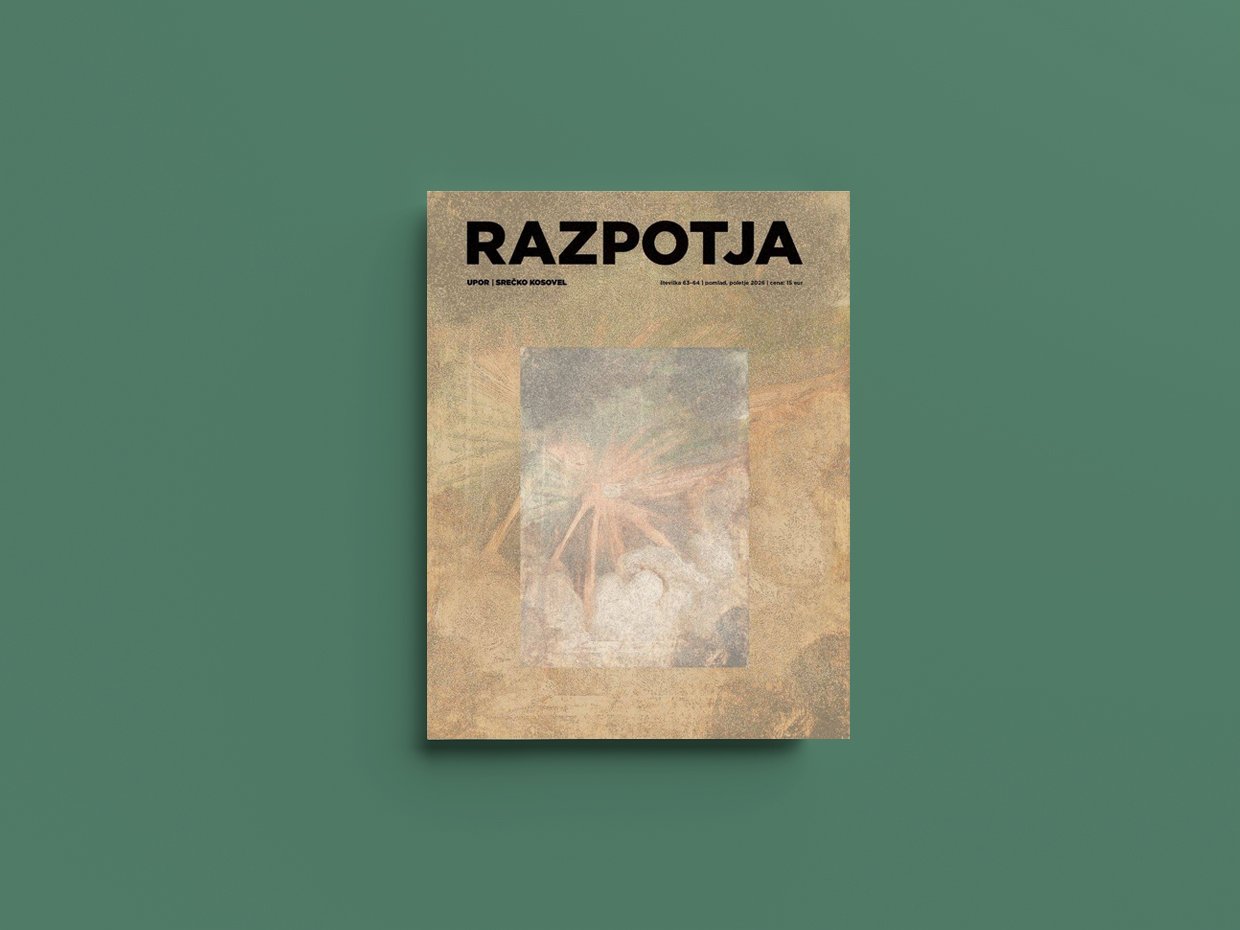
Marking the centenary of the dying of Slovenian avant-garde poet Srečko Kosovel, Razpotja explores the character, legitimacy and limits of insurrection, from classical political philosophy and historic uprisings to modern activism and cultural dissent.
A literary innovator and social critic, Kosovel challenged the conventions of his time, whereas his poetry additionally captured the anxieties of a technology residing within the aftermath of the First World Battle.
Right now, observes editor Luka Lisjak Gabrijelčič, ‘we’re youngsters of a world that celebrates insurrection and even elevates it right into a sort of obligation’. However at a time when safeguards towards previous catastrophes are beneath assault, a clear-eyed sense of accountability towards a world in disaster is maybe extra applicable than the heady romanticism of insurrection.

Aristotle on insurrection
Ought to we perceive insurrection as a aware course of that brings about change, or as a symptom of deeper, longer-term developments? And when is insurrection justified, if in any respect?
To reply these questions, Gašper Kvartič turns to antiquity, starting with Aristotle’s influential classification of six constitutional kinds. His central distinction was not merely who governs, however whose pursuits the federal government serves. Kingship, aristocracy and polity serve the widespread good, whereas their corrupted counterparts – tyranny, oligarchy and democracy (a pejorative time period in Aristotle’s mannequin) – serve the pursuits of explicit teams. For Aristotle, insurrection (stasis) was the catalyst of political transformation, bringing new factions to energy.
The Greek historian Polybius, nevertheless, supplied a special studying of historic change. Extra eager about a diachronic perspective, he developed Aristotle’s framework right into a idea of cyclical constitutional change, often called anacyclosis. Rebel, on this view, just isn’t the driving drive of historical past however a consequence of the ‘inside logic of constitutional kinds,’ as Kvartič places it, whose gradual corruption and decline finally provoke upheaval.
How helpful are these theories for understanding historic rebellions? The complexity of precise human programs, Kvartič concedes, complicates their direct software. Nonetheless, each views illuminate occasions such because the French Revolution and the collapse of European communist regimes.
Thomas Aquinas launched the ethical dimension. Shifting the dialogue from political evaluation to political ethics, he regarded insurrection as a violation of pure legislation, permissible solely beneath distinctive circumstances, notably towards tyrannical rule.
In the end, whether or not we see insurrection because the catalyst of change, the consequence of historic decline, or an act requiring ethical justification, Kvartič means that ‘the true knowledge in discussions of insurrection lies in what stays unsaid’: ‘the artwork of eliminating the situations that might result in insurrection’.
France’s ironic saint
Marc Bloch was inducted into the Panthéon on 23 June of this yr, with a lot pomp and fanfare. The nice medievalist and steadfast Resistance fighter was thus celebrated as ‘France’s final saint for the twenty-first century’, writes historian Junhao Yang.
But the ‘actual Bloch’, Yang contends, would have seemed on with attribute irony. Bloch was no court docket historiographer however a ruthless anatomist and an ardent demythologizer. In his 1924 masterwork, Les Rois thaumaturges, he dissected with the objectivity of an anthropologist the parable of the ‘royal contact’: the persistent perception that English and French monarchs might remedy scrofula just by laying their arms on victims.
Bloch’s historic technique, histoire-problème, was an injunction to interrogate, to stay ever important. Nothing was immune from this scrutiny, not even his personal mental legacy: as soon as the Annales faculty’s ‘whole historical past’ had ‘ossified into a brand new sort of oppressive mythology’, it fell to his mental descendants to dismantle it.
Making use of the identical analytical rigour to Bloch’s canonization, Yang warns towards decreasing the ceremony to the cynical exploitation of lifeless mental capital. Sustaining a political phantasm is a two-way avenue, requiring each state-sponsored mythmaking and public complicity.
We should as an alternative probe the situations that maintain this delusion: the enchantment of Bloch’s elevation to the Panthéon lies not merely in political expediency but additionally in a collective craving for a determine able to bridging modern societal divides, of respiratory new life into an exhausted political imaginary.
But taking refuge in a sanitized, mythologized determine is exactly what Bloch’s historic follow warned towards. When the swelling nationwide orchestra threatens to drown out important thought, our civic accountability is to not venerate Bloch however to learn him, Yang concludes. Solely then can his discordant tones minimize by the din.
Posthumous assimilation
Nikodem Szczygłowski explores the intricacies of nationwide belonging and cultural reminiscence by the destiny of Ilya Repin, certainly one of Russia’s most celebrated nineteenth-century painters, regardless of his Ukrainian origins and later rejection of the Soviet Union.
Repin’s case was hardly distinctive: the Russian Empire was adept at ‘bringing many formidable folks into its ranks’. Like Nikolai Gogol, Repin was a cultural product of an empire that exerted ‘a sexy and assimilating affect’. But each remained wedded to their Ukrainian roots, which knowledgeable their oeuvres and afforded them the paradoxical perspective of an ‘inside outsider’.
Having spent a lot of his life in St Petersburg, Repin retreated to the pine forests of Kuokkala, a small city within the autonomous Grand Duchy of Finland. When Finland gained independence following the October Revolution, the painter, fiercely hostile to the Bolsheviks, discovered himself safely on the Finnish facet of the border.
Stalin subsequently despatched a delegation of Soviet artists to steer Repin to relinquish his life in Finland, an overture he firmly rejected. Repin died in Kuokkala in 1930.
However the empire wouldn’t depart him be. Following the Winter Battle and subsequent territorial struggles, Kuokkala grew to become a part of the Soviet Union for good. In a merciless historic irony, the Soviet authorities renamed the city Repino, making the reluctant artist its namesake.
As Szczygłowski writes, ‘if it couldn’t declare the residing artist for itself, it no less than took possession of his grave’.
Evaluate by Cadenza Educational Translations