
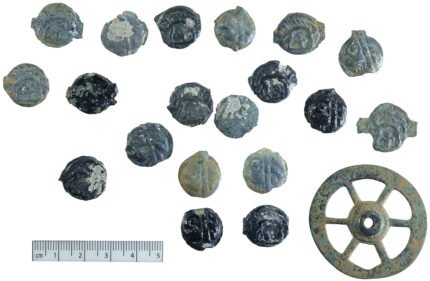
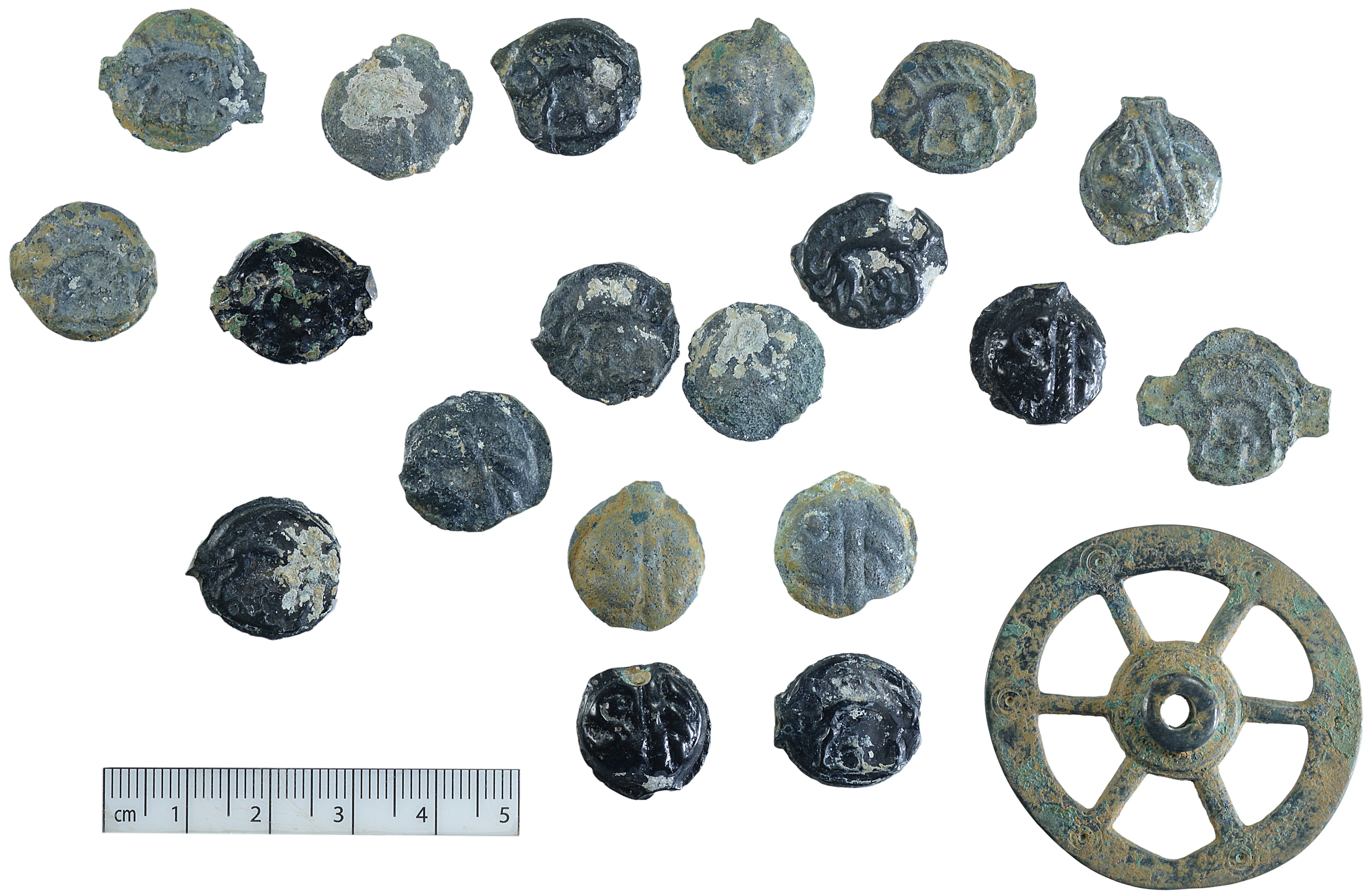
 A small hoard of cash has been found in a late Iron Age construction in Bure, northeastern France. They’re Gallic cash that had been solid in a mould quite than struck, and a few of them have the casting shank nonetheless connected.
A staff from the French Nationwide Institute for Preventive Archaeological Analysis (INRAP) discovered 4 holes within the corners of a sq.: postholes, proof of a construction constructed on posts on an oblong ground plan. Alongside one of many lengthy facet, 28 cash had been found in a small pit.
They’re Gallic potins of a sort often known as an “Indian head” as a result of it bears the profile of a person sporting a scarf on the reverse. That is believed to be a extremely stylized modification of a coin of Philip II of Macedon. A lot of the cash bear the army commonplace of the wild boar with stiff again bristles over a small fleur-de-lis on the obverse. The “boar commonplace” potin is quite common in northeastern France.
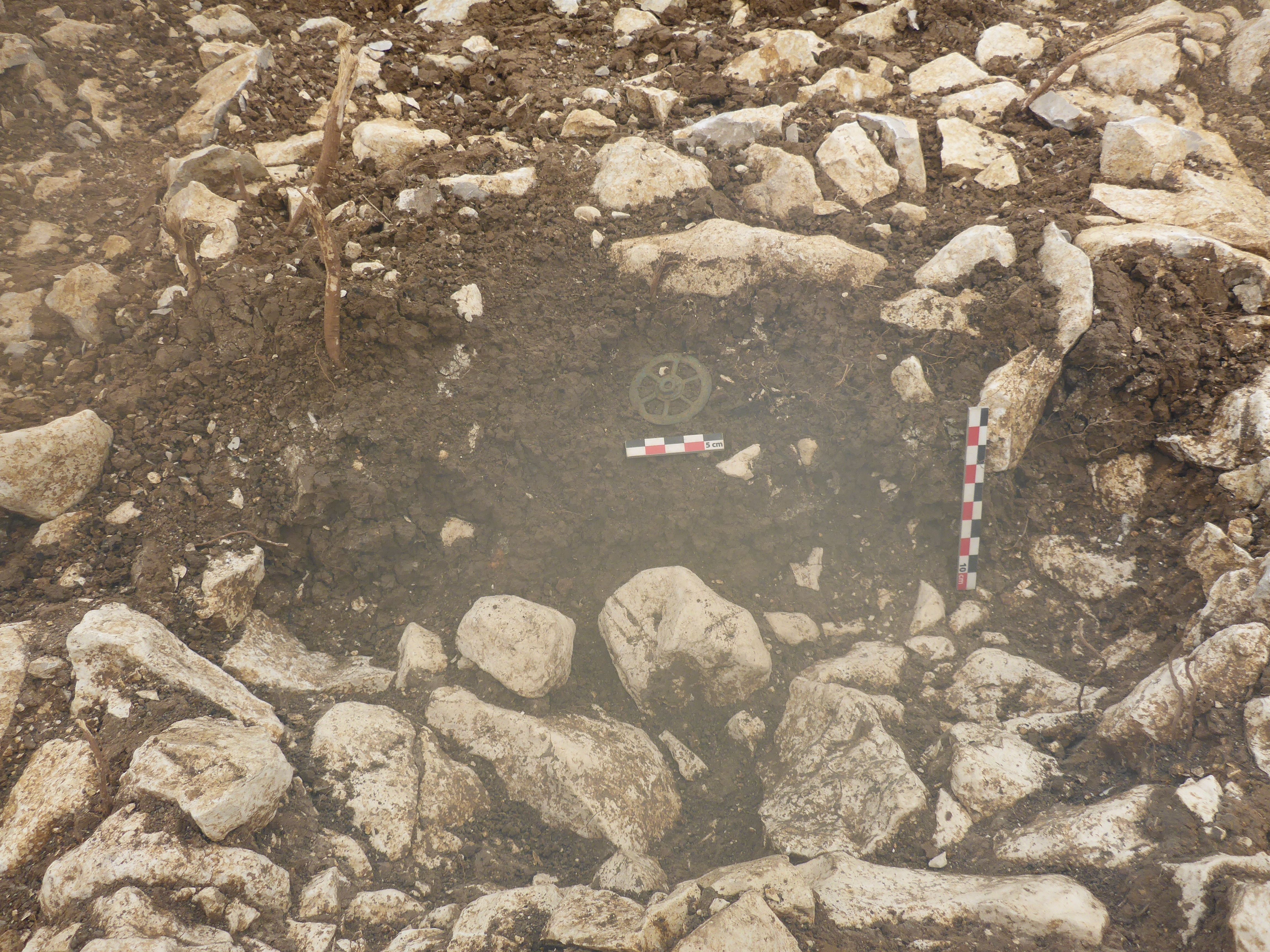 Archaeologists additionally discovered a small bronze wagon wheel 5 cm (two inches) in diameter. It’s adorned with swirls. The aim of those objects is unknown, however they’re sometimes present in a votive context. The wheel factors to the chance that the construction had a non secular perform. The invention of human ones in one of many postholes additionally suggests it could have been a sanctuary.
Regardless of their fragmentary state, the bulk had been cranium bones (notably the mandible). It’s fairly widespread for Gallic sanctuaries to yield human skulls, though they can be present in home contexts. Within the best-known examples, the sanctuaries are normally clearly demarcated by a deep ditch, as at Gournay-sur-Aronde (Oise) or Ribemont-sur-Ancre (Somme). Nonetheless, maybe attributable to erosion, the excavation didn’t reveal any demarcation system (fence, palisade, and many others.). A geophysical survey was carried out a month after the fieldwork, however it did not uncover any enclosure or different demarcation options.
If that is certainly a Gallic sanctuary, which subsequent analysis will try and confirm, related to a big coin hoard found inside its stratigraphic context, this archaeological occupation is unprecedented within the territory of the Leuci and really uncommon throughout Belgic Gaul.