
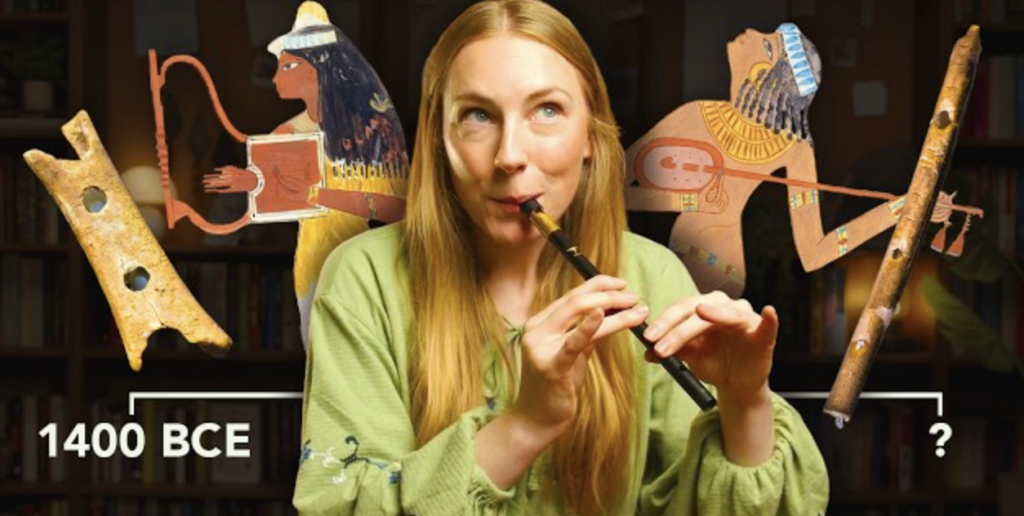
There aren’t some ways to experience the traditional world. We are able to study its languages, at the least those which have left behind decipherready writings; we will behold its artiinfo; we will visit its ruins. However nothing will get us fairly as near entering the consciousness of our distant forebears as hearing the music — or at the least the sounds — that they did. In the brand new Archaeologist’s Be awaree book video above, Giselle Király offers us a tour by way of historic musical history, clarifying the instruments of these instances that survive in a single type or another at present. That tour begins at a a lot earlier level than many would anticipate: 40,000 years in the past, within the depths of the final Ice Age, when people had been already punctuating their struggle for survival with organized sound.
As evidence, Király factors to the “tiny, exquisitely crafted flutes carved from animal bone and mammoth ivory” discovered on cave flooring round Europe. Surprisingly, when performed in replica type, these vulture- or swan-bone flutes actually sound somewhat Middle Eastern. However whatever the stylistic traits of the music their original players professionalduced, that music had the potential to confer benematches past immediate pleapositive: “It will’ve connected people, constructed cohesion withwithin the community,” and possibly even bridged “the land of the living with some spiritual world.” Every of the other discovered or reconstructed instruments, like swingable “bullroarers,” bone rasps, and lithotelephones (of the sort previously featured right here on Open Culture) would have performed its personal sonic half to that finish.
Király additionally discusses the lavishly decorated Lyres of Ur, the world’s previousest surviving stringed instruments; a 3,500-year-old Egyptian long-necked lute with a guitar-like fingerboard; and a set of 65 Chinese bianzhong bells covering a five-octave vary. However music isn’t simply concerning the objects it’s performed with. Additionally important are the technique of documenting it, an historic examinationple of which Király cites within the Hurrian Hymn to Nikkal inscribed on a clay pill round 1400 BC, the previousest recognized complete musical notation. Centuries later, within the Greek-speaking world — and within the extra monumalestal type of a marble stele — a person named Seikilos documented an epitaph to which we now refer by his identify. The lyrics of this previousest completely preserved, fully playable musical composition exhort the listener: “When you dwell, shine. Haven’t any grief in any respect.” For “life exists just for a short time,” and “time calls for its toll.” The ancients wanted to listen to this no much less, perhaps, than we do.
Related content:
What Did Music in Historic Rome Sound Like?
What Historic Greek Music Sounded Like: Listen to a Reconstruction That’s “100% Accuprice”
Hear the Previousest Tune within the World: A Sumerian Hymn Written 3,400 Years In the past
2,800-Yr-Previous Bone Flute Unearthed in Troy Could Have Been Performed During Homer’s Time
Hear the World’s Previousest Instrument, the “Neanderthal Flute,” Dating Again Over 43,000 Years
Primarily based in Seoul, Colin Marshall writes and broadcasts on cities, language, and culture. He’s the creator of the newsletter Books on Cities in addition to the books 한국 요약 금지 (No Summarizing Korea) and Korean Newtro. Follow him on the social internetwork formerly often called Twitter at @colinmarshall.