
This week Michael Taylor, Affiliate Professor of Historical past at SUNY Albany returns with an actual deal with: a transhistorical primer on mixed arms warfare – why it issues, why it’s arduous and the way it’s accomplished – stretching from the very early Iron Age to the current. Mixed arms is a kind of ideas that will get name-checked so much in remedies of historic armies, however is much extra hardly ever outlined and mentioned intimately, but the satan is within the particulars – the precise mechanics that make a military greater than the sum of its elements.
And with that, over to Michael…
One of the tough duties for a military to perform is mixed arms operations, the combination of several types of troops working collectively on the battlespace to perform a shared tactical and operational process. For many of pre-modernity, mixed arms operations concerned coordinating between cavalry, heavy infantry and lightweight infantry. Probably there have been completely different sub-divisions inside these primary sorts, for instance closely armored cataphracts and horse archers are each cavalry, however the truth is combat fairly in a different way: a cataphract makes a shock cost straight into the enemy whereas a horse archer shoots on the transfer, usually flitting out and in of vary from the enemy. Equally, mild infantry as a class would possibly comprise multitudes: slingers, archers, javelineers, and so on. Heavy infantry, outlined right here as infantry with adequate armor or shielding to carry a place, might need delicate gradations as effectively: for instance in a Roman manipular legion the excellence between hastati and principes armed with heavy javelins (pila) and triarii armed with thrusting spears. In fashionable instances, mixed arms refers to coordination between the fight arms branches of infantry, artillery, armor (together with “cavalry” scouts in armored autos) together with fight aviation property like assault helicopters. These in flip are supported by fight help (engineers, ordinance, and so on.) and fight service help models (logistics, medical asssets, civil affairs and so on.).
In fashionable navy parlance, Mixed Arms refers to operations inside providers, whereas actions that contain property from throughout the providers (i.e. Military, Navy, Air Pressure, Marines and now, heavens assist us, the House Pressure) are known as Joint Operations. As an extra wrinkle, frequent throughout time might be what in the present day could be known as Mixed/Joint Multinational Operations which contain allied international locations. Most armies, notably for big imperial states, have been additionally multi-ethnic, in order that facilitating mixed arms meant not simply integrating cavalry and lightweight infantry, however doing so with mild infantry and cavalry models that spoke completely different languages and practiced very completely different martial traditions and institutional cultures.
Challenges
Mixed arms operations when accomplished effectively present various, mutually complimentary methods of partaking the enemy. Sadly, mixed arms operations are fairly tough to do effectively. It’s value contemplating a minimum of a couple of the reason why:
Fight mechanics: The principle purpose mixed arms is difficult is that combating kinds are sometimes incompatible, or a minimum of tough to deconflict. Cavalry will advance sooner than infantry. Gentle infantry can advance and retire sooner than heavy infantry, however can not maintain floor when challenged in shut fight. Heavy infantry want to take care of formation to maximise weapons attain and the mutual safety of shields, whereas mild infantry swarm. Such variations will solely be dramatically extra sophisticated in fashionable mixed arms, the place the disparities between a tank, a cell artillery piece and a groundpounding soldiers might be much more profound. Easy questions, like ought to a tank have a phone within the again in order that infantry can name in to speak to the crew (the M1 Abrams famously eschewed this till the TUSK updates of the Iraq Battle) have nice tactical import.
Management. How do leaders know combat and coordinate the completely different arms underneath their command? Most leaders come up studying combat a method. Throughout pre-modernity, most aristocrats who grew to become generals had beforehand served as cavalrymen, and needn’t have had a granular mastery of, say, heavy infantry techniques. Certainly, Kelly DeVries has argued that one side that made Joan of Arc an efficient navy chief was that as a peasant lady she deigned to talk with commoner artillerists and so accrued little insights in regards to the new know-how that France’s different chevalier-class marshals neglected. Conversely, whereas George S. Patton minimize his tooth as a pioneering tank officer in WWI, one is struck studying his memoirs how a lot thought and consideration he dedicated to infantry fight. Fashionable officers likewise come up from serving as junior and mid-level officers in a specific department, though the US Military just lately mixed the Armor and Infantry right into a Maneuver department to easy the divide. Such specialization is usually needed and even inevitable, but it surely additionally signifies that senior leaders can have a sure myopia in the case of mixed arms operations.
Standing: Not all kinds of soldier get pleasure from the identical social standing, each inside the military itself and probably within the society from which completely different troopers are recruited from. For many of premodernity, cavalrymen had a dramatically larger standing than soldiers (each heavy and lightweight), by no means extra so than the armored knights of the European Center Ages. Heavy infantry oftentimes claimed a better standing than mild infantry, with the latter usually supplied both by poorer males or foreigners. As shocking as it could appear, American infantry throughout World Battle II held a surprisingly low standing, with formidable and better aptitude volunteers leaning in direction of the Air Corps, Airborne standing or USMC. This led to concerted makes an attempt to enhance the status of the infantry department, together with the introduction of the Fight Infantry Badge. Within the twenty first century, the terribly excessive standing of Particular Forces slightly reverses the historic development, with elite mild infantry fetishized over common mechanized infantry, armor and artillery. Standing differentials can result in tensions and resentments that gum up efficient mixed arms operations. And so they can even exacerbate all types of tactical pathologies: low standing troops may be used as cannon fodder, or socially elite troops may be dispatched on high-profile missions they’re the truth is ill-suited for (for instance the dismounted frontal assault of French knights at Agincourt).
Logistics: Several types of troops can have very completely different logistical wants. A contemporary tank platoon requires huge portions of gasoline, ammunition, and a gentle stream of specialised alternative elements, whereas an infantry platoon might need extra mundane necessities for “beans, bullets and band-aids.” In some unspecified time in the future in a mixed arms operation, a logistical officer and commander should show themselves accustomed to the wants of assorted kinds of models. In antiquity, cavalry had appreciable logistical necessities, as horses required massive quantities of meals and fodder and water. Offering missiles to premodern mild infantry, be they arrows or sling bullets, was one other excessive finish logistical downside. Marcus Crassus suffered defeat Carrhae (53 BC) in no small half as a result of the Parthian commander Surena had organized a particular camel convoy to resupply his horse archers, dismaying the legionaries who had hoped (not fully with out purpose) the enemy would simply run out of arrows. The English state in the course of the Hundred Years Battle likewise grew to become fairly adept at sustaining a centralized arrow provide that undergird its well-known victories.
Associated to standing, some kinds of troops merely value extra, which may result in penny pinching in the case of deploying the optimum density of sure arms. In premodernity, the excessive standing of cavalrymen, mixed with the logistical necessities of sustaining horses, meant that cavalrymen merely value rather more. A Roman cavalryman in the course of the Republic was paid 3 times that of an infantryman. In Medieval England, a typical foot archer was paid about 2-3 pence a day, whereas a knight acquired a full two shillings a day (24 pence). Value differentials may additionally result in tactical pathologies, for instance by the later phases of the Hundred Years Battle the English tended to discipline too many archers and never sufficient men-at-arms, a sub-optimal composition within the discipline, provided that archers have been defenseless and not using a bulwark of men-at-arms, however far cheaper to take care of in garrison.
Spectrum differentials: mixed arms operations concentrate on main theater wars. However main theater wars are sometimes rare, and the interim substantial navy exercise might be dedicated to garrison duties, counterinsurgency, or what may be known as petit guerre, i.e. skirmishing, wars of posts, and different permutations of small-scale battle. The troop composition for these extra frequent operations is completely different from what’s required for intensive hegemonic warfare. However frequent petit guerre additionally shapes the experiences of troopers and leaders. The US Military realized within the 2010s that a lot of its mixed arms muscle had atrophied in Iraq and Afghanistan, the place infantry, armor and artillery models usually have been retooled to carry out missions related to mild infantry or navy police (for instance convoy escort or foot patrols). The fetishization of Particular Forces is a associated phenomenon: SF is a kind of sunshine infantry very helpful in counterinsurgency and counterterrorism even when too delicate to be something underneath than a supporting asset in a significant theater conflict, all of the whereas siphoning gifted and impressive troopers away from line models.
With Our Arms Mixed
In the end mixed arms could be very arduous to do, with many structural components militating in direction of sub-optimal efficiency. So how do profitable armies handle mixed arms effectively? Maybe the most important query for a power construction is what organizational degree to combine mixed arms operations? Three primary choices current themselves: 1) integration on the small unit degree (e.g. squads, platoons or firms; 2) integration on the degree of the first tactical echelon (e.g. brigades or divisions) and three) integration on the army-level.
Small Unit Integration: Throughout World Battle II it was fairly efficient to connect a tank or tank destroyer to help an advancing infantry platoon or firm, thus integrating armor and infantry on the small unit degree. In some cases throughout avenue combating, particular person artillery items have been even used to blast out positions to permit infantry platoons to advance. In sub-state or weak-state armies constituted on a “retinue of retinues” mannequin, the retinue itself is usually a mixed arms reflecting mobilization alongside social hierarchies all beholden to the retinue chief. In the course of the European Excessive Center Ages, a knight’s banner would possibly embody the knight himself, maybe with two or three different mounted men-at-arms of equal or near-equal standing (serjeants, gros valets, squires, and so on.) together with a handful of dependents who served as infantry or archers. This was primarily a mixed arms squad. Since this can be a Tolkien pleasant zone, it may be famous that the Fellowship of the Ring is exactly such a Medieval mixed arms retinue, with a pacesetter (Gandalf), two men-at-arms (Boromir, Strider), an archer (Legolas) a shock infantryman (Gimli) and 4, er, very mild footmen. Trying again to antiquity, the enigmatic Celtic trimarkisia could have functioned on the same precept, with a mounted aristocratic warrior bringing alongside two subordinates who may combat on foot or mounted because the circumstances dictated. Archaic Greek hoplite warfare, the place seventh century BC hoplites fought intermixed with mild infantry and archers, probably functioned on the same social foundation, with a rich man combating with armor and huge aspis shields flanked by his frivolously armed dependents, whereas the wealthiest flexed throughout the battlefield of their chariots. The casual pairing within the Iliad (which can mirror consciousness of extra formal Assyrian mixed arms techniques practiced on the time of the poem’s composition) of Larger Ajax and his brother Teucer, whereby Teucer shoots his bow from behind his brother’s tower protect, envisions a casual mixed arms technique on the degree of the buddy workforce, though within the Iliad it’s hinted they work effectively collectively not just because they’re of the identical noble standing, however due to their brotherly bond.

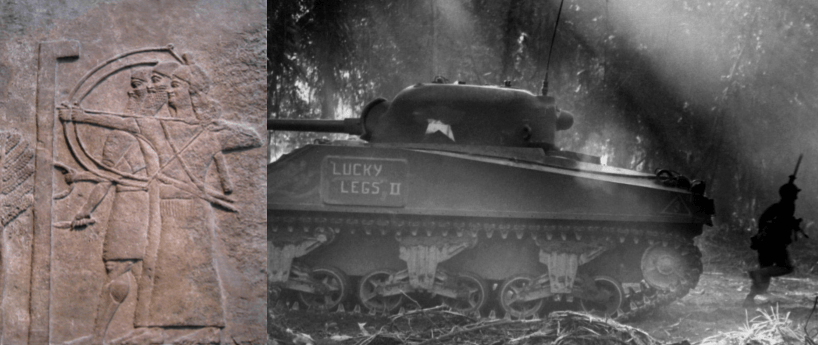
Extra formal makes an attempt to combine archers and shieldmen on the degree of the infantry file might be seen by the Assyrians, the primary nice state military of the Iron Age. Assyrian shieldmen and archers are sometimes depicted combating in pairs, with spear-armed shieldmen defending the archer. Assyrian heavy infantry and archers may additionally segregate, for instance in the course of the remaining assault of a metropolis, with heavy soldiers scaling ladders whereas the archers lay down a base of “hearth.” The Achaemenid Persians appear to have largely continued the follow of blending several types of troopers inside a single infantry file, though they deepened the file past the Assyrian pairing, so {that a} shieldman, typically with a big spara shields protected a number of ranks of archers, who themselves may additionally combat with spears, shields and swords as soon as they ran out of arrows, that’s double as each mild and line infantry. Certainly, having troopers put on two hats as each mild and heavy infantry was a not unusual, if not at all times profitable answer throughout historical past.

But expertise more and more confirmed that uniform formations of heavy infantry was one of the best ways to maximise each the protecting qualities of shields and armor, and in addition the shock worth of the infantry assault. Think about a simplified fight state of affairs the place a closely armed infantryman is combating subsequent to an archer. If this pair is attacked by two opposing closely armed soldiers (whose shields and armor have deflected the archer’s arrows) then the almost definitely result’s the archer is shortly killed and the surviving footman now faces two opponents. Higher to have a line of simply hoplites. By the fifth century BC, and doubtless earlier, mild troops have been kicked out of the hoplite phalanx, which grew to become a pure heavy infantry formation. On the Achaemenid aspect, it appears that evidently some models had at all times fought primarily as spearmen, however by the fourth century BC the Achaemenids have been making use of Greek-style hoplite formations, typically using Greek mercenaries or typically their very own topics, just like the Lycians on the Xanthus reliefs, additional substituting a minimum of a few of their combined shieldman/archer formations with extra uniform heavy infantry.
Military Degree Integration: Thus within the historical Greek world by the Classical interval the most typical echelon of mixed arms integration was the military itself. No sub-unit contained a mixture of mild infantry, cavalry, and heavy infantry, however the commanding common managed the tactical interplay of main models of various arms as a part of the grand battle plan. Generals levying armies wanted to make sure their general power had the right mixture of hoplites, cavalry and lightweight infantry (psiloi). In battle, a recurring answer throughout antiquity was to put heavy infantry within the heart, screened to the entrance or flanks by mild troops, with cavalry posted on the flanks the place they might maneuver. However coordinating amongst these nonetheless required a deft contact. The early fourth century BC Athenian commander Iphicrates supposedly likened the best mixed arms integration of a military to the human physique: the peltasts provide the fingers, the cavalry the toes, the hoplites the cuirassed chest, and the overall himself the top coordinating the exercise of the congruent elements. Notably, Iphicrates thought of mixed arms integration the first process of the overall. Iphicrates himself was accountable for bettering the standard of Athenian mild infantry, each by way of their tools, together with the usage of a Thracian type heart grip protect, the pelte, and thru recruiting peltasts from wealthier males who had historically served as hoplites––that’s elevating the social standing of sunshine infantry service as a way of accelerating its tactical salience. Iphicrates inflicted a devastating defeat on a bunch of Spartan hoplites at Lechaion in 391 BC, when these made the error of making an attempt to maneuver in open nation with out mild infantry or cavalry screens, solely to undergo devastating attrition by hit-and-run techniques from the brand new peltast power. The beleaguered Spartan commander additionally didn’t know make the most of the cavalry that ultimately got here to his support, retaining them alongside his hoplites, slightly than permitting them to cost forward to decisively disrupt the hit-and-run sequence. It could be that the Spartan commander, socialized within the peculiar Spartan system of sq. bashing, merely suffered “hoplite mind” and had not thought via one of the best ways to deploy a cavalry asset.
Alexander the Nice was arguably the simplest mixed arms commanders of pre-modernity. His father, Philip II, had solid a military that mixed heavy cavalry drawn from the standard Macedonian aristocracy with a heavy infantry power of pikemen recruited from the free peasantry. To assist tie-in the principle pike phalanx in with the cavalry cost, Philip created a particular unit of hypaspistai (“shield-bearers”), primarily swifter and maybe considerably extra frivolously armored phalangites who may surge ahead to fill the hole between the cavalry cost and the extra slowly advancing infantry. After all, as mentioned above, standing differentials between arms branches can hinder efficient cooperation. The normal social standing of Macedonian heavy cavalry was extraordinarily excessive: cavalrymen noticed themselves as “companions” hetairoi to the king. Philip couldn’t promote excellent social equality, however he may easy the disparity by elevating the status of his pike infantry, dubbing them pezhetairoi “foot companions.” Whereas the title of hypaspistai beforehand referred to a servant who carried a hoplite’s protect, Philip’s hypaspists noticed themselves as collective shield-bearers to the king himself, a really lofty company standing (late in Alexander’s reign, this unit could be given silver plated shields and rebranded because the argyaspides, additional testifying to their excessive standing). As Macedonia’s hegemony waxed, and the military was supplemented by international topics and subaltern allies, ethnic solidarity as Makedones proved an necessary power binding collectively the core one-two punch of pikemen and heavy cavalry.

Macedonian mixed arms techniques labored partially as a result of there was an ordinary working process (SOP) for a way the main items would function collectively in pitched battle: the cavalry on the left could be refused (held again) whereas the center-right component would launch an echelon assault, with the cavalry on the proper main, the hypaspistai appearing as a versatile connector and the phalanx advancing its mass at its personal tempo, screened by mild skirmishers, who additionally helped defend the intense flanks and rear of the formation. This SOP meant that the king as common didn’t have to spend so much of time and bandwidth producing novel methods for his military to work collectively, and that the troops and their officers developed patterns of cooperation and communication. On this “Alexander Battle” combined-arms SOP, the king solely needed to make a couple of key selections to impact the fastidiously decided plan: when and the place to launch his cavalry cost (that’s discovering a weak point within the enemy line to take advantage of), after which when he ought to minimize quick his pursuit to roll up the principle enemy line. Simpler mentioned than accomplished, and the important thing to Alexander’s generalship was his immaculate coup d’oeil, his skill at a look to evaluate the sweeping grand tactical scenario after which strike on the most opportune second (in Greek the kairos) and site. As soon as Alexander had made his willpower, he may steer his total mixed arms power by charging ahead himself: the place Alexander rode, he may be certain his elite bodyguards (somatophylakes) would observe, adopted in flip by his hetairoi cavalry, themselves tethered to the principle phalanx by the hypaspists. However an issue emerged as soon as Alexander drank himself to loss of life in Babylon: this mixed arms plan required a superb and impressed commander to drag it off. Alexander’s successors imitated his type and continued to try to combat the Alexander battle, however with out his praeternatural success. This downside has been identified by Graham Wrightson, who particularly argues that the Seleucid king Antiochus III merely couldn’t pull off Macedonian mixed arms techniques with the identical verve and aptitude.
It’s attainable to diagnose explicit issues successor kings tended to do flawed. A typical error was to over pursue on the cavalry cost, that’s the king received too concerned combating a cavalry-on-cavalry motion that he did not pivot to satisfy the broader mixed arms plan. This was the blunder of Demetrius Poliorcetes at Ipsus (301 BC), of Antiochus III at Raphia (217 BC) and of Antiochus III ( he simply couldn’t give up) at Magnesia (190 BC). The seemingly easy issues Alexander did have been the truth is fairly arduous. The Seleucid military particularly had the tendency to accrue a huge bric-a-brack of sunshine infantry models, who cluttered the flanks with out including a lot to the principle battle. However the bigger subject was organizational. It’s fairly tough to combine mixed arms on the degree of the military, and integration at this degree locations extraordinary strain on the overall and his senior workers to make sure that all the varied cogs and gears and widgets of the mixed arms machine whirred easily. Certainly, integration on the military degree is determined by having a navy genius as a common, and suffers from any commander’s toes of clay.
Major division integration: There’s a blissful median between usually chaotic small unit integration on the degree of a retinue or platoon and integration on the degree of the military. Arguably the simplest option to nest mixed arms operations is on the degree of the principle subdivision of the military. This was how the US Military organized itself to combat World Battle II. Then the principle sub-unit was the division of roughly 15,000 troopers. Importantly, troopers have been inspired to establish themselves corporately with their divisions. This was the unit patch that they wore on their proper shoulders, and certainly if a soldier noticed fight with a division, he was allowed to put on that patch on his left shoulder for the remainder of his profession. This company esprit d’ corps was necessary exactly as a result of the division was a significant locus for mixed arms integration.
After all, US divisions carried labels of “Infantry” or “Armor,” however in actuality, to borrow a time period from mixology, we would contemplate these “Infantry ahead” or “Armor ahead” mixed arms divisions. Already throughout World Battle I, US infantry divisions had a regiment of artillery nested with (this was comparatively customary worldwide follow, it ought to be famous). However that is exactly what routine mixed arms integration seems to be like: natural integration on the main tactical unit. Whereas a US infantry division didn’t have natural armor throughout World Battle II, the US Military maintained separate tank and tank destroyer battalions which could possibly be connected to help explicit infantry divisions. This association was not with out potential frictions, because the separate battalions risked changing into institutional orphans when it got here to tools and alternative personnel, though inertia usually noticed sure tank or TD battalions connected to a specific division for an prolonged interval, which supplied the likelihood for the event of long term working relationships, a semi-organic connection if you’ll. For instance, the 743th Tank Battalion was connected to the thirtieth Infantry Division from June 14th 1944 to VE Day; the ensuing mixed arms component, 9 infantry battalions, three artillery battalions, and a semi-organic tank battalion famously defeated a infamous German mixed arms component, Kampfgruppe Peiper, alongside the Ambleve River in the course of the opening phases of the Battle of the Bulge (Dec. 18th–twenty fourth, 1944). KG Pieper consisted of a medium panzer battalion, a heavy panzer battalion of Tigers, a battalion of mechanized infantry (panzergenadiers) and a towed artillery battalion. The face-off between a US infantry division with artillery and armor, and a German armored battlegroup with infantry and artillery demonstrates the extent that twentieth century mixed arms follow converged via institutional isomorphism.
American armored divisions throughout World Battle II in the meantime have been an much more natural mixture of tanks, mechanized infantry and cell artillery. To interrupt down institutional obstacles to mixed arms exercise, US armored divisions have been divided into three fight instructions (CCA, CCB and a reserve CCR) which could possibly be allotted a mixture of tank, mechanized infantry and cell artillery battalions. This precept (like a German Panzerkampfgruppe) allowed the division commander large flexibility to combine and match mixed arms capabilities to fulfill the mission, whereas troopers retained their esprit d’corps on the degree of the division whilst their battalions and firms shuffled between Fight Instructions. Certainly, this precept pointed to how the US military would manage itself going ahead, ultimately putting off single-arms regiments, and making the Brigade (at present Brigade Fight Group, BCT) the first degree the place mixed arms integration occurred (fixed tweaks are ongoing). If there’s a flaw within the present BCT mannequin, troopers are nonetheless inspired to establish with their umbrella Divisions and their august WWII heritage, whilst fight arms integration is targeted on the Brigade. The exception is the Nationwide Guard, the place some previous WWII divisions have been retooled as brigades, together with the thirtieth Cell Brigade Fight Group of the North Carolina Nationwide Guard, the legacy unit of the storied World Battle II division.
Mixed arms on the degree of a significant tactical subdivision was comparatively uncommon within the historical world. A salient exception was the manipular legion of the Center Republican Rome. This follow originated considerably accidentally. Early Rome had initially levied a single legion (the phrase legio simply meant “levy”), which consisted of sunshine troops, heavy infantry and aristocratic cavalry, the precept of mixed arms integration on the degree of the military. However within the mid-fourth century BC, in all probability because of the Licinio-Sextian reforms that created the classical consulship, the Romans doubled the levy so that every consul may command a single legion. By 311 BC, every consul was assigned two legions, so {that a} legion was now a very powerful subdivision of the Roman military; this additionally meant that mixed arms was built-in on the degree of the legion, which had 1200 mild infantry (velites) 3000 heavy infantry (divided into three traces, triplex acies, of hastati, principes and triarii) and 300 cavalry.
Whereas the cavalry was usually indifferent to the wings in pitched battle, the completely different arms of the legion steadily labored hand-in-hand, each operationally in the course of the marketing campaign and tactically throughout pitched battle. Velites guarded the camp perimeter in the course of the day whereas the maniples rotated via the night-watch, supervised by the cavalry. Within the marching column, cavalry both rode interspersed behind their natural infantry, or have been brigaded to guard the luggage practice, essentially the most susceptible a part of the marching formation. Closing with the enemy, velites usually accompanied the cavalry to skirmish and seize ahead positions. In pitched battles, velites screened the entrance of the triplex acies because it fashioned its battleline whereas cavalry fashioned as much as defend its susceptible flanks. As soon as the triplex acies had damaged the enemy formation, the cavalry pursued and massacred enemies of their flight.

The social boundaries between the completely different arms of the legion overlapped on the edges. Many heavy soldiers within the triplex acies had initially served as velites earlier than ageing into heavy infantry service. A few of the wealthiest males within the infantry can have skilled service as each soldiers and cavalrymen cum equis suis (males who supplied their very own horse, in distinction to aristocratic cavalry who have been issued a public horse at state expense). It’s notable that velites don’t appear to be seen as cannon fodder in the best way that Excessive Imperial authors would later view auxiliary cohorts combating in entrance of the legions. Cavalrymen may even be known as upon to labor digging ditches for siege works when needed (though in a single occasion they have been roundly punished for refusing to take action). Shared citizenship and social overlap eased among the rivalries and social frictions that corrode the efficacy of mixed arms operations.
Moreover, subordinates under the extent of the military commander may facilitate mixed arms integration. The pairing of velites with cavalry troopers at Capua in 211 BC, the place by the velites rode double after which leapt all the way down to combat one foot, was facilitated by a legionary centurion named Quintus Navius. Army tribunes, the six elected officers who staffed every legion, had beforehand served as cavalrymen, however carried the sunshine target-shield of the velites, the parma, and circulated, just like the velites did, in between and to entrance of the heavy-infantry maniples. The natural place of sunshine infantry was notably integral to manipular techniques, the place the matrix of heavy infantry was screened and maintained by the heart beat of velites out and in of the manipular checkerboard. Roman commanders may and did detach mild infantry and cavalry parts as their battle plan required. However this detachment needed to be the aware alternative of the commander. Mixed arms integration was the default setting for the legion, one thing it did effectively even when the commander did not put a lot thought into it.
Perplexingly, after Rome succeeded in conquering the Mediterranean, it dismantled the legion as a mixed arms power. The legions of Julius Caesar’s Commentaries (c. 58–44 BC) are composed fully of cohorts of heavy infantry, supported by inorganic cavalry and lightweight infantry supplied by Gallic and Germanic allies. It took Caesar’s genius to make this work effectively. Whereas some residents would later serve in legionary cavalry in the course of the civil wars, and it’s attainable that some citizen mild infantry models additionally persevered, the natural mixed arms of the Center Republican legion was clearly a factor of the previous by the Late Republic. Why ought to this be?
We will solely speculate, however prices and logistics could have performed a task. A single horse can take up as a lot area on a ship as 5 males. Roman commanders could have most well-liked to depend on auxiliary mild infantry and cavalry which could possibly be recruited within the theater, and infrequently paid for by topic communities. Comparative benefit could have performed a task as effectively, as Rome acquired topics who have been higher mild infantry (like Balearic slingers) and cavalry (such because the Numidians and Gauls). The draw back was that whereas a Numidian horseman or Balearic slinger may be a greater man-for-man than a Roman eques or veles, the benefits of a mixed arms legion have been misplaced. Certainly, now obstacles of language, tradition and authorized standing stood between mixed arms exercise. Moreover, there may be proof that heavy Roman legionaries have been usually compelled to be their very own mild infantry: Caesar maintained particular troops known as antesignani who have been able to dashing ahead to grab ahead positions. Caesar himself criticized Pompeian legionaries for surging ahead in a unfastened and haphazard style however they probably superior in a swarm just like the velites as soon as did exactly as a result of that they had no mild infantry accomplish that as an alternative. The legion-level manufacturing of sling bullets within the Late Republic raises the query of who was doing the slinging, and the obvious default was that some legionaries have been ahead deployed to function slingers, maybe earlier than falling again into their cohorts for pitched fight. This was removed from splendid, and notably, the Roman military clawed some mixed arms group within the early imperial interval, with every legion regaining about 125 cavalrymen, whereas plenty of auxiliary cohortes equitanae functioned as mixed arms battalions, mixing of six centuries of infantry (480 foot) and 4 turmae of cavalry (120 riders).
Apparently, the reception of the Roman legion within the 18th century was very a lot as a mannequin of mixed arms fight. Afterall, schoolboys after a couple of sound whippings may learn their Livy and Polybius and be taught that the legion was an empire constructing mixture of infantry, lights and cavalry. As fashionable mixed arms developed, a “legion” grew to become the time period for a unit that mixed common line infantry, skirmishers like riflemen, discipline artillery, dragoons (mounted infantry) and common cavalry. This may be seen within the historical past of the Revolutionary Battle, the place the notorious Banastre Tarleton commanded the British Legion, composed of loyalist People, a considerably chaotic mixture of infantry and dragoons, principally well-known for committing conflict crimes. Within the 1790s, the brand new nation itself raised the Legion of the US after set-backs in early makes an attempt to ethnically cleanse the Ohio Valley within the 1790s. Approved at a classically resonant paper energy of 4000 troops, the Legion of the US built-in line infantry, riflemen skirmishers, dragoons and artillery firms. None of those “legions” sought to strictly replicate the tactical group of the Roman legion, by way of maniples, cohorts or the triplex acies. However the emulation nonetheless went deeper than simply cribbing the title, and actually mirrored a delicate studying of navy historical past: the Roman legion had proved dominant not essentially due to ineffable components just like the genius of its generals and even the valor of its troopers, however due to the sensible matter that it was the institutional locus for natural mixed arms integration.